- Hewlett Packard Enterprise posted record Q2 FY2026 revenue of approximately $7.6 billion, with its AI server order backlog growing by roughly $1 billion during the quarter.
- HPE reported zero order cancellations in its AI hardware segment, suggesting enterprise customers are treating infrastructure buildouts as committed, long-term programmes rather than speculative purchases.
- HPE’s GreenLake platform, which offers consumption-based pricing for on-premises AI infrastructure including pre-configured LLM environments, is the mechanism the company is using to convert hardware deals into recurring service revenue.
Hewlett Packard Enterprise just posted its strongest quarter on record, with $7.6 billion in Q2 FY2026 revenue and an AI server backlog that grew by roughly $1 billion in a single quarter. More telling than the revenue number: the company says not one AI hardware order was cancelled. In a market that has seen plenty of speculative over-ordering, that’s a meaningful signal about where enterprise infrastructure spending actually stands.
HPE’s Q2 FY2026: A Deep Dive into Record Performance
The headline number is $7.6 billion, a record for HPE and enough to prompt a raise in full-year guidance. The AI server backlog expansion drove most of the excitement on the earnings call, but it wasn’t the only bright spot. The Intelligent Edge segment posted revenue growth of an estimated 10% year-over-year, showing the company isn’t a one-product story.
The Intelligent Edge segment also showed strong performance, demonstrating the company isn’t a one-product story. The backlog growth matters because it reflects conversion, not just orders.
The backlog growth matters because it reflects conversion, not just orders. HPE managed to pull a significant portion of its existing backlog into recognised revenue during the quarter, which points to supply chain execution holding up under pressure. CEO Antonio Neri is said to have cited AI server demand as the primary driver on the earnings call, with the company’s ability to manage component supply as a key operational factor.
The AI Server Catalyst: Fueling HPE’s Ascent
The roughly $1 billion backlog increase isn’t coming from a single customer type. Demand spans hyperscalers, enterprise data centres, government agencies and research institutions. What they share is a need for validated, scalable AI infrastructure rather than individual components they have to integrate themselves.
HPE’s current AI server portfolio is built around NVIDIA H100 GPUs, with positioning underway for the Blackwell architecture. But GPU access is only part of the story. Running large-scale AI workloads requires the full stack: high-speed interconnects, storage that doesn’t bottleneck the accelerators, and cooling that keeps everything running at rated performance. HPE’s ProLiant servers are being adapted with liquid cooling for this reason, and its InfiniBand and Ethernet networking solutions provide the low-latency fabric that distributed AI training demands. The pitch to customers is a validated, integrated system rather than a build-it-yourself procurement exercise.
Beyond the Hype: The Significance of “No Cancellations”
Zero cancellations in the AI hardware segment is the detail worth sitting with. Technology procurement cycles have a history of over-ordering followed by sharp corrections as priorities shift. The fact that HPE’s AI backlog is holding without attrition suggests customers aren’t hedging. These are committed orders.
Part of the explanation is structural. High-performance AI hardware, particularly GPU-dense systems, involves long lead times and substantial integration planning. By the time an organisation is placing an order, it has typically already committed the data centre space, the power capacity and the engineering resources to support it. Cancelling at that point has real costs, but the deeper signal is that enterprises are moving AI out of pilot programmes and into core operations, where the infrastructure is no longer discretionary.
GreenLake’s Strategic Play in the AI Era
HPE GreenLake is the company’s consumption-based hybrid cloud platform. Customers deploy compute, storage and networking on-premises or in co-location facilities and pay for actual usage rather than upfront capital. For AI workloads, which tend to be spiky and hard to capacity-plan accurately, that model has real appeal. It converts what would otherwise be a large capital expenditure into operational spending, which CFOs generally prefer.
HPE has built out GreenLake specifically for LLM and HPC workloads, offering pre-configured environments with the software stacks, orchestration tools and managed services needed to run AI at scale. For organisations that don’t have deep MLOps capability in-house, that’s a meaningful reduction in deployment complexity. The business case for HPE is straightforward: GreenLake converts a one-time hardware sale into a recurring service relationship, with ongoing visibility into how customers are using the infrastructure and what they’ll need next.
Navigating the Supply Chain: GPU Access and Competitive Landscape
HPE is delivering H100-based systems and is positioning for Blackwell supply.
The competitive field is crowded. Dell Technologies brings deep enterprise relationships and a comparable server portfolio. Supermicro competes on speed and configurability, with a reputation for getting high-density designs to market quickly. HPE’s counter is the integrated stack: servers plus networking plus storage plus GreenLake managed services, all under one contract. Whether that end-to-end model commands a price premium or simply reduces friction for customers making large infrastructure decisions, it’s a different sale than a rack of servers on its own.
Technical Prowess: Liquid Cooling and High-Density AI Racks
A rack of H100s can exceed 10 kilowatts of thermal output. Air cooling struggles at that density, and data centres designed for traditional workloads often can’t handle the heat load without expensive facility upgrades. Liquid cooling isn’t a nice-to-have for serious AI deployments, it’s the enabling condition.
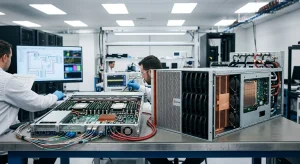
HPE’s approach includes direct-to-chip cooling, where coolant circulates over the processors directly, and rear-door heat exchangers that capture heat before it enters the data centre environment. Both approaches reduce the burden on facility-level cooling infrastructure and improve power usage efficiency. The engineering foundation here comes partly from the Cray lineage. The HPE Cray XD series applies supercomputing-grade cooling and high-density packaging to enterprise AI deployments, bringing a level of thermal engineering maturity that most server vendors are still developing. For data centre operators trying to run more GPU capacity in existing footprints without triggering facility upgrades, that matters.
Hybrid Cloud for AI: Addressing Diverse Enterprise Needs
Not every AI workload belongs in a public cloud. Regulated industries face data residency requirements that make public cloud deployment legally complicated. Manufacturers running inference at the edge need systems that operate without cloud round-trips. Financial institutions training on proprietary trading data aren’t moving that data off-premises. For all of these, on-premises or co-location deployment is the only viable option.
GreenLake sits at the intersection of those constraints and the operational preferences of teams that have grown used to cloud-like flexibility. Large-scale model training can run on dedicated on-premises HPC clusters. Edge inference can run on compact, ruggedised systems. Workloads that are less sensitive or that spike unpredictably can burst to public cloud. HPE’s argument is that enterprises shouldn’t have to choose a single architecture, and that GreenLake is the management layer that ties the pieces together. How well that argument holds up against the continued build-out of AWS, Azure and Google Cloud’s own on-premises and hybrid products is the open question. For more on how AI agents interact with cloud and API infrastructure, see our coverage of agentic API security developments.
Competitive Positioning: HPE Against Dell, Supermicro, and Cloud Giants
The public cloud providers are legitimate competition here, not just background context. AWS, Azure and Google Cloud all offer GPU instances, managed ML platforms and increasingly sophisticated AI-as-a-service products. Their scale advantages are real. HPE’s response is to lean into the gaps: data sovereignty, latency-sensitive edge applications, compliance requirements and the total cost of ownership for organisations running sustained, predictable AI workloads where reserved on-premises capacity is cheaper over a three-to-five year horizon than cloud consumption.
The HPE Private Cloud AI initiative, which integrates NVIDIA’s AI platform with HPE’s enterprise hardware and software, is the clearest expression of that positioning. It targets enterprises that want the operational simplicity of a managed AI environment without the data residency trade-offs of public cloud. Whether it’s differentiated enough to hold share as the cloud providers push deeper into hybrid is a reasonable sceptical question. HPE’s long-standing enterprise reputation and existing customer relationships provide a foundation, but the technical gap between what public clouds offer and what on-premises systems can deliver is closing in both directions.
What To Watch: Key Signals for HPE’s AI Future
Four things are worth tracking as HPE moves through the second half of FY2026.
GPU supply continuity is the most immediate. Blackwell access will determine whether HPE can keep converting its backlog at the current rate. Any supply disruption hits revenue directly and gives competitors an opening. The supply chain execution that helped Q2 results will need to hold.
GreenLake’s AI workload growth is the longer-term signal. The consumption model is attractive in theory; the question is how quickly mid-market enterprises adopt it for complex AI deployments, not just standard IT workloads. Customer retention rates and AI-specific revenue within GreenLake will indicate whether the platform is genuinely changing HPE’s revenue mix or just repackaging existing hardware sales.
Liquid cooling capacity is increasingly a competitive differentiator as GPU power envelopes grow. HPE’s Cray-derived thermal engineering is an asset, but scaling that capability to meet broader enterprise demand requires manufacturing investment and supply chain depth on the cooling hardware side as well as the compute side.
Finally, the software and management layer. HPE Ezmeral and the broader AI software stack determine whether customers see HPE as infrastructure they run, or a platform they operate on. The latter is a stickier and more valuable position. Partnerships with AI software vendors and enhancements to orchestration and lifecycle management tooling will signal which direction HPE is moving. For more coverage of AI chips and infrastructure, visit our AI Hardware section.