- UK chip startup Fractile raised $720 million in a Series C round on November 11, 2026, lifting its post-money valuation to $7 billion, up from $1.1 billion just six months earlier.
- Co-led by Thrive Capital and backed by the British Sovereign AI Venture Fund, the capital is earmarked for 2027 commercial deployment of Fractile’s inference chips, which embed memory directly into the die to address the bandwidth wall that throttles large-model throughput.
- Fractile claims its architecture runs AI models up to 25 times faster at a tenth of the cost of existing hardware, and has reportedly agreed a $250 million chip supply deal with Anthropic, though both figures are unconfirmed by independent testing and no production chip has shipped yet.
Six months after closing a $220 million Series B, London-based Fractile has raised $720 million more, vaulting its valuation from $1.1 billion to $7 billion before shipping a single production chip. The November 11, 2026 Series C, co-led by Thrive Capital and backed by the UK government’s own sovereign AI fund, makes it the largest European semiconductor funding round on record, according to UK Chancellor John Healey.
The Memory Bandwidth Problem
Fractile was founded in 2022 by Walter Goodwin and Yuhang Song to attack a specific hardware constraint: memory bandwidth. Computational throughput in chips has grown sharply over 25 years, but memory bandwidth has not kept pace. The result is that large AI models spend much of their time waiting for weights to arrive from memory rather than actually computing. Goodwin describes the experience as “drinking through a straw.”
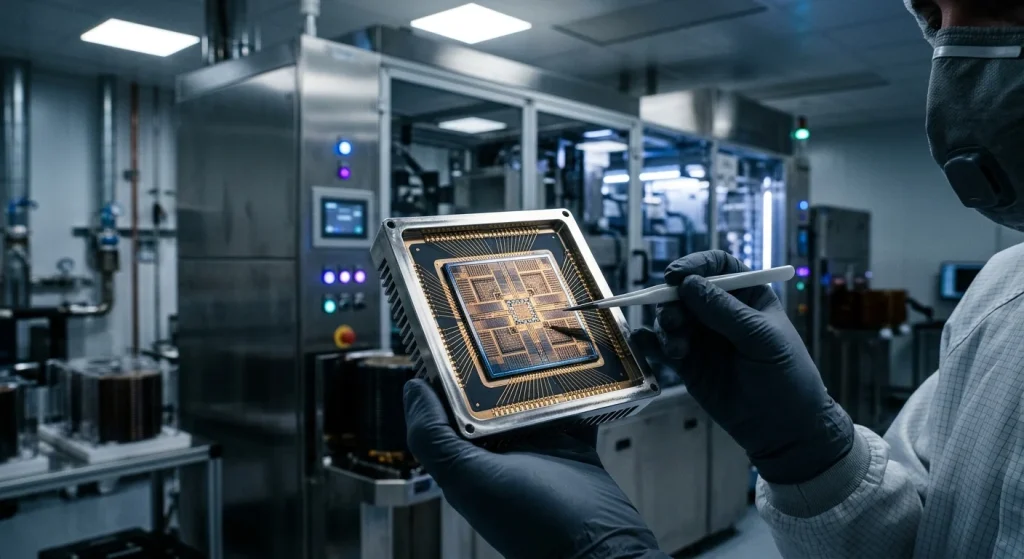
Fractile’s answer is to build custom memory directly into the chip die, physically interleaving memory and compute elements. That architecture keeps data movement short and dense, delivering higher bandwidth and lower latency than a conventional GPU with discrete DRAM. The target workload is long-token inference, where the memory wall is felt hardest and where the cost and latency penalties of GPU clusters are most visible.
Who’s Backing the Round
Thrive Capital, Founders Fund, Lightspeed and Redpoint co-led the Series C. CapitalG, BlackRock, DST Global and Balderton also participated. The British Sovereign AI Venture Fund and the British Business Bank represent the UK government’s stake, framed explicitly as industrial policy: retaining AI semiconductor jobs and supply-chain capability inside Britain rather than ceding the ground to US or Asian producers.
Competing With Nvidia
Nvidia still supplies the overwhelming majority of processors used for both AI training and inference. Fractile is one of several startups targeting the inference side specifically, where workload characteristics differ enough from training that a purpose-built chip can in theory outperform a general-purpose GPU. Fractile claims its chip runs AI models up to 25 times faster at one-tenth the cost of existing hardware, according to the company’s own figures. Independent benchmarking has not yet confirmed either claim, and no production silicon has shipped.
The company has also reportedly reached a supply agreement with Anthropic worth approximately $250 million, covering chip deployments planned for 2027. That deal, if it closes on those terms, would give Fractile a named anchor customer before its first commercial chip reaches volume production.
What Comes Next
Fractile’s first production chip is expected to ship commercially in 2027. The valuation jump from $1.1 billion to $7 billion in six months is a measure of investor appetite for inference-optimised silicon, not of demonstrated performance at scale. The performance and efficiency numbers Fractile cites will face their real test once hardware is in customer hands. Until then, the $720 million buys time to find out whether the architecture delivers what the benchmarks promise.