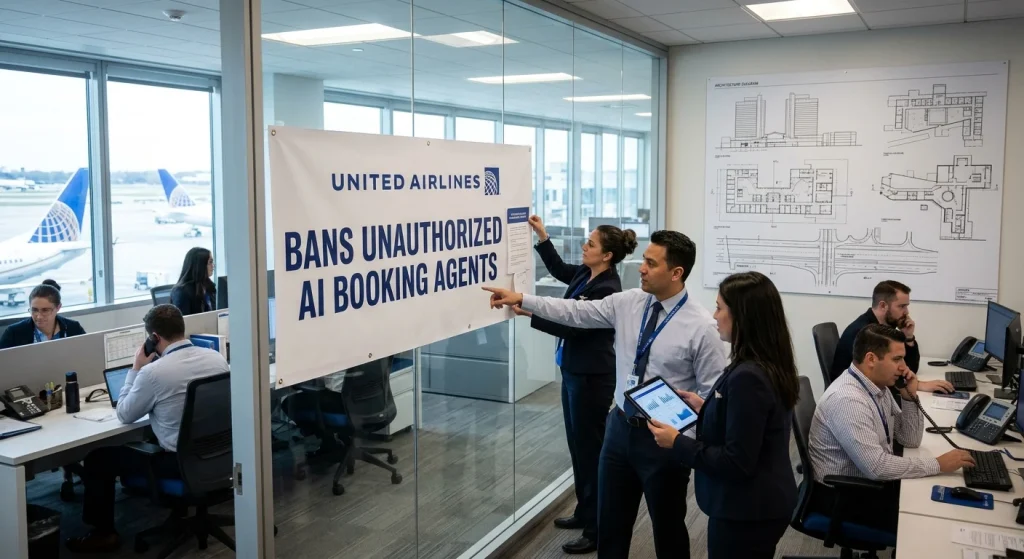
- United Airlines updated its contract of carriage on November 11, 2026 to ban unauthorized third-party AI agents from booking, modifying or servicing tickets, and reserved the right to cancel any reservation made in violation.
- CEO Scott Kirby has cited the commercial logic directly, saying United wants to avoid a new distribution intermediary between itself and customers; separately, United points to FAA check-in affirmation rules that cannot legally be delegated to an automated system.
- The contract language gives United explicit authority to cancel reservations made by unauthorized agents, a direct risk for any team routing bookings through third-party automation.
United Airlines wrote a clause into its contract of carriage on November 11, 2026 that any reservation made or modified by an unauthorized AI agent can be cancelled outright. The policy puts United against where part of the industry is heading: Southwest and the major online travel agencies are opening up to third-party AI booking, while Delta keeps outside agents locked out too, offering its own first-party AI assistant instead.
Customer Data at Stake
The security argument is straightforward: handing account credentials to a third-party AI agent exposes MileagePlus balances, payment details and personal itineraries to systems United does not control. Loyalty accounts have drawn sustained attention from attackers, and the airline is not extending implicit trust to agents it has not vetted. JPMorgan Chase and Amazon have taken the same position on their own platforms, blocking unauthorized agent access on privacy and security grounds.
The Regulatory Constraint
Federal rules create a harder problem. During check-in, passengers must personally confirm their baggage contains no prohibited materials, a legal affirmation an AI agent cannot make on a traveler’s behalf without creating a compliance problem for the airline. The FAA and Department of Transportation requirements are not ambiguous, and United’s position is that no automated system should be completing that step without direct human acknowledgment. That exposes a real gap in what current AI agents can handle in regulated workflows, not a capability ceiling, but a legal one.
Keeping Customers Off Other Platforms
CEO Scott Kirby has been direct about the commercial logic. United does not want AI agents becoming a new distribution layer between the airline and its passengers, the same role online travel agencies filled a generation ago. According to Kirby, the volume of AI bot flight searches already carries a cost, and allowing agents to complete bookings would extend that cost while pushing customer relationships further from United’s direct control. A booking completed through a third-party agent is a booking where United loses the relationship, and both MileagePlus and the airline’s proprietary digital platforms are revenue assets worth protecting.
The Industry Split
Southwest has gone the other direction, building a plugin that lets ChatGPT users browse its flight inventory and reach its website through the AI interface. Delta’s own AI assistant, Delta Concierge, completes bookings and changes once a customer authenticates through SkyMiles — a first-party tool rather than the third-party agents United is targeting. Delta has separately said it has no partnership enabling outside AI agents like ChatGPT or Muse to book directly on its platforms. OpenAI is reportedly in talks with Expedia and Booking.com to integrate AI into their booking flows, though no named source has confirmed the specifics of those arrangements. Some travel companies are treating AI agents as a new channel to cultivate; United is treating them as one to close.
The specific language in United’s revised contract bans “the use of AI Agents to make, modify or service a Ticket” and gives the airline explicit authority to cancel reservations made that way. For any team building travel automation, that clause is the operative fact.


