- A June 2026 UN University report projects AI infrastructure could consume 945 terawatt-hours of electricity annually by 2030, roughly three times the combined annual use of Pakistan, Bangladesh and Nigeria.
- AI hardware’s compressed two-year replacement cycle, down from seven years for conventional IT, could generate up to 2.5 million tonnes of e-waste annually by 2030, per the same UNU report.
- TSMC consumed 101 billion litres of water in 2023, and the UNU report projects AI-related water consumption could match the basic annual domestic needs of 1.3 billion people by 2030, with chip factories concentrated in water-stressed regions.
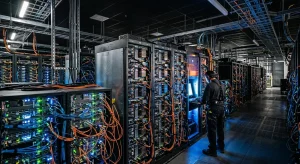
A June 2026 UN University report puts a hard number on AI’s physical footprint: the global infrastructure running AI could consume 945 terawatt-hours of electricity annually by 2030, roughly three times the combined annual use of Pakistan, Bangladesh and Nigeria. Power is only part of the problem. The same infrastructure is accelerating an e-waste crisis, straining water supplies from Arizona to Taiwan, and generating significant carbon emissions before a single GPU ever runs a workload.
The Energy Surge and Grid Strain
The International Energy Agency has projected a significant increase in global data centre electricity consumption by 2030, driven largely by AI accelerator workloads. Pre-training a large language model can consume hundreds of thousands of GPU-hours, and the carbon cost of that work includes the amortised emissions from manufacturing the hardware itself.
For facilities on average-carbon grids, operational emissions dominate the total. For data centres running on renewables or nuclear, the balance shifts: embodied emissions from construction and hardware manufacturing become the larger share of lifetime greenhouse gas output. That distinction matters for how operators account for their climate exposure, and for how much a renewable energy purchase agreement actually moves the needle.
The Thirsty Chip Factories
TSMC consumed 101 billion litres of water in 2023, and consumption is rising as next-generation process nodes, with more circuit layers and tighter tolerances, demand even more. The UNU report projects AI-related water consumption could match the basic annual domestic needs of 1.3 billion people by 2030.
Geography sharpens the risk. Around 40% of existing fabs and more than 40% of new fabs announced since 2021 are located in areas projected to face high or extremely high water stress by 2030. That creates supply chain exposure alongside community-level impact. Google‘s data centre in Cerrillos, Chile, drew public criticism for drawing approximately 7.6 million litres of drinkable water daily in a region experiencing a megadrought. Hyperscale facilities generally, not just that one site, can run into the millions of gallons per day.
E-Waste Accelerates
AI workloads push chips harder than conventional data centre tasks, and that compresses replacement cycles. Traditional IT hardware was typically refreshed every seven years. AI’s demands have cut that to roughly two years, according to reports, as operators swap out hardware to maintain performance and avoid breakdowns. Amazon has already reduced the useful life of its servers from six to five years, according to reports.
The UNU report projects this accelerated obsolescence could generate up to 2.5 million tonnes of e-waste annually from AI infrastructure by 2030. A separate study by data scientist Alex de Vries-Gao of Vrije Universiteit Amsterdam, published in February 2026, puts the figure lower, at 131 to 224.8 kilotonnes annually by 2030, still comparable to the total annual e-waste output of Denmark or Norway.
The composition of AI server waste matters as much as the volume. GPUs, CPUs, memory modules, storage and power supplies all carry toxic substances including lead, mercury and chromium. Improperly processed, these contaminate soil and water. Only a small fraction of global e-waste is formally recycled. Microsoft reports a 92% hardware reuse and recycling rate, using robotics to disassemble equipment and recover materials, but that figure covers one company’s own operations. IT asset disposition at the industry scale needed to handle specialised AI hardware reaching end-of-life remains an open problem. For a deeper look at how AI workload growth is reshaping data centre resource planning, see our coverage of AI workloads driving data centre power demand.
Embodied Carbon and Supply Chain Pressure
Most of a mobile device’s carbon footprint is tied to fabrication, with chip manufacturing accounting for a substantial portion of that. The same logic applies, at much larger scale, to AI accelerators. Advanced chip production relies on extreme ultraviolet lithography, a process demanding high-energy photons and substantial electricity. It also uses potent greenhouse gases such as nitrogen trifluoride, which carries a global warming potential 17,000 times that of CO2. High-Bandwidth Memory, now standard in AI accelerators, stacks DRAM dies vertically using through-silicon vias to deliver the memory bandwidth large models require; HBM’s manufacturing process adds its own emissions load. Research published at Harvard by Gage Hills suggests the energy required to manufacture a chip can exceed that chip’s total energy consumption over a 10-year operational life.
Pressure for supply chain disclosure is building. A shareholder resolution filed by Green Century Capital Management on June 30, 2026, at Nvidia’s annual meeting asked the company to report climate emissions generated by customers using its products. The resolution won 18% of votes. The filing noted that competitors AMD and Intel already estimate and disclose their product-use emissions, which can account for up to three-quarters of a chip designer’s total emissions. Microsoft, for its part, is specifying lower-carbon construction materials for new facilities and using procurement to push suppliers toward lower-emissions products.
The 945 TWh projection, the water demands of advanced fabs, the compressed hardware refresh cycles: each is a discrete engineering constraint, not a branding problem. Each requires a specific technical response. General sustainability commitments do not move these numbers. For more coverage of AI chips and infrastructure, visit our AI Hardware section.