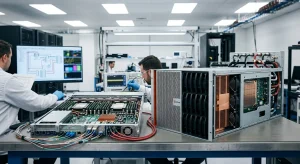
- DeepSeek’s reported plan to deploy 160,000 Huawei Ascend 950DT chips at a new Inner Mongolia data centre confirms that China’s AI infrastructure build-out has moved to execution, not planning.
- China’s MIIT is targeting 9,800 exaFLOPS of intelligent computing capacity by 2030, backed by $532 billion in planned investment over five years.
- US export controls have made Chinese buyers avoid US chips even where licences exist, with Nvidia forecasting near-zero data centre revenue from China in the following quarter.
DeepSeek’s reported plan to deploy 160,000 Huawei Ascend 950DT chips at a new Inner Mongolia data centre, disclosed in early September 2026, arrived the same week Beijing’s Ministry of Industry and Information Technology published a five-year plan targeting 9,800 exaFLOPS of intelligent computing capacity by 2030. The coincidence is striking: a major commercial cluster commitment and a national capacity target landing together suggest China’s domestic AI hardware strategy has found its footing.
China’s Domestic Build-Out
The scale of DeepSeek’s proposed cluster matters because it confirms Huawei’s Ascend line can attract large commercial customers, not just state-directed deployments. China’s MIIT plan, announced on September 7, 2026, allocates approximately $532 billion for cumulative information infrastructure investment between 2026 and 2030. Hitting that target requires domestic chip supply at a scale China has not previously achieved.
Huawei’s HiSilicon division is the primary supplier. Production of Ascend chips reportedly scaled from 300,000 units in 2025 to a projected 600,000 units in 2026, with 1.6 million chips across all models in the pipeline. Chinese cloud providers including Alibaba Cloud, Huawei Cloud and Baidu AI Cloud are actively adapting workloads to run on Ascend hardware. DeepSeek‘s V4 model, released in April 2026accelerated enterprise interest in domestic hardware by demonstrating that frontier-grade performance was achievable without US chips, as we covered in our analysis of China’s narrowing AI cost gap.
Market research firm TrendForce projects Huawei’s total AI chip revenue will grow 60% year-over-year to $12 billion in 2026, with domestic alternatives taking substantial ground from Nvidia and AMD across the Chinese market. The overall Chinese high-end AI chip market is projected to grow by more than 60% in 2026, per the same firm, with Huawei holding roughly half of the domestic market.
Export Controls and Market Fracture
US chip export restrictions have produced a market outcome that neither side initially anticipated: Chinese buyers are actively avoiding compliant US products even where licences exist. The Trump administration’s December 2025 decision to permit exports of Nvidia’s H200 processors under a new licensing scheme led to shipments in the quarter ending July 26, 2026, yet those sales accounted for less than 1% of Nvidia’s quarterly data centre revenue. Nvidia’s guidance for the following quarter assumes no data centre computing revenue from China at all. Chinese regulatory authorities have, according to reports, actively discouraged domestic AI companies from purchasing American chips, treating US vendors as unreliable partners regardless of licence status.
The regulatory framework has shifted repeatedly. The Biden administration’s January 2025 AI Diffusion Rule introduced licensing requirements for advanced chip sales to Chinese firms operating overseas. That rule faced partial suspension in May 2025. Commerce Department guidance issued on May 31, 2026, then clarified enforcement to restrict sales to Chinese subsidiaries outside China, language that implicitly acknowledged previous illicit transactions. As of March 2026, the US government was also drafting broader controls that could require approval for advanced AI processors shipped to any destination outside the United States, including allied nations, with large transactions potentially requiring host-country government sign-off. Those rules, if finalised, would cover AMD and Nvidia shipments globally.
Supply Chains Shift West
TSMC’s July 2026 capital budget increase to between $60 billion and $64 billion for the year reflects AI demand pulling manufacturing investment toward geography as much as technology. The additional $100 billion US commitment, bringing TSMC’s total planned US investment to approximately $265 billion, is earmarked for at least four more advanced logic wafer fabs at 2nm and below, plus advanced packaging facilities in Arizona. The Arizona cluster would expand to at least 10 fabs and two advanced packaging sites. As CHIPS Act incentives pull more advanced capacity to the US, the geography of where frontier chips are physically made is changing faster than the underlying technology roadmap.
Intel announced a €5 billion investment in July 2026 to upgrade its Ireland manufacturing campus, deepening its Intel Foundry position in Europe and supporting future Xeon processors on the Intel 3 process. Taken together, these moves amount to a deliberate redistribution of advanced semiconductor manufacturing across allied nations. The effect extends beyond fab location: raw material sourcing, advanced packaging capacity and logistics networks are all being reconfigured around the assumption that concentrated production in any single geography is a strategic liability.
Bottlenecks Beyond the Chips
High-bandwidth memory is now the binding constraint on AI accelerator supply. The surge in data centre construction has created an HBM shortage that Micron Technology expects to persist beyond 2026, driving cost inflation across the electronics supply chain and forcing buyers into long-term capacity commitments for components they previously sourced on demand through cloud providers.
Nvidia retains an estimated 80% to 85% of the data centre AI accelerator market by revenue, according to TrendForce. AMD’s share has risen to an estimated 5% to 7%, driven by MI300X and MI325X adoption for inference workloads at hyperscalers including Microsoft and Meta.
The Supercomputing Race
China’s chip self-sufficiency efforts are backed by a substantial subsidy commitment toward an 80% self-sufficiency target, though the timeline and specific funding mechanism have not been publicly disclosed in detail.
The US State Department was reportedly pressing partner countries by August 2026 to avoid initiatives seen as duplicating or competing with US efforts on critical minerals, semiconductors and AI infrastructure. That posture has created friction with countries like Singapore, whose economies are entangled with Chinese AI markets.