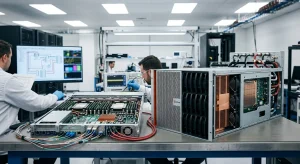
- Colocation providers are upgrading facilities to support AI workloads demanding 30kW to over 100kW per rack, with next-generation racks projected to reach 370kW.
- Liquid cooling is now standard infrastructure for high-density AI hardware, with TrendForce projecting 53% penetration among AI chips in 2026.
- New power delivery architectures, including NVIDIA’s 800 VDC racks, are being introduced to meet AI’s extreme power demands and accelerate GPU deployments.
Equinix posted $2.625 billion in Q2 2026 revenue, up 16.4% year-on-year, and raised its full-year guidance, with AI infrastructure demand cited as the primary driver. The numbers from Equinix and Digital Realty this quarter tell a consistent story: colocation providers are becoming the physical backbone of enterprise AI, and the infrastructure required to support it looks nothing like what was built five years ago.
AI Drives Colocation Investment
Digital Realty reported record bookings in Q2 2026, with a development backlog of $1.9 billion, much of it tied to hyperscale and AI initiatives. Both companies are deploying capital at a pace that reflects sustained, not speculative, demand.
Enterprises are choosing colocation and hybrid environments for AI and ML workloads rather than building proprietary facilities. The economics are straightforward: power-dense, purpose-built colocation space is faster to access and cheaper to scale than greenfield construction, particularly when GPU clusters require specialised electrical and cooling infrastructure that most corporate campuses cannot support.
Extreme Power Densities Redefine Racks
Traditional data centre racks draw 5-15kW. AI-optimised racks require 30kW to over 100kW, and next-generation configurations are projected to reach 370kW in 2026. That is not an incremental upgrade, it is a complete re-evaluation of power delivery, structural loading and thermal management at the facility level.
The grid pressure is real. US data centre power demand is projected to grow from 31 GW in 2025 to 66 GW by 2027, with AI infrastructure buildout as the primary driver. Wholesale electricity costs near US data centres have reportedly surged sharply, as local substations struggle to keep pace. Colocation providers are effectively competing for grid access as much as for customers, and those with secured power capacity hold a structural advantage in a constrained market. The broader trajectory of AI power demand points toward sustained pressure on grid infrastructure well beyond 2027.
Liquid Cooling Is Now Standard
High-density AI hardware generates heat that air cooling cannot handle at scale. TrendForce projects liquid cooling penetration among AI chips will reach 53% in 2026 and approach 60% in 2027. Direct-to-chip cold plates and coolant distribution units are now part of the standard procurement conversation alongside the silicon itself, not an afterthought, not an upgrade path.
Google reportedly uses liquid cooling on more than 80% of its AI servers. Immersion cooling and rear-door heat exchangers still serve specific use cases, but direct-to-chip has become the default for hyperscale AI deployments. For colocation providers, this means facilities without liquid cooling infrastructure are increasingly uncompetitive for the highest-value workloads. The shift toward liquid cooling is reshaping how providers price and provision new capacity.
Rethinking Power Delivery
NVIDIA working with Google and Microsoft through the Open Compute Project, is introducing MGX-compatible 800 VDC power racks in the second half of 2026. The architecture delivers 800 VDC directly to compute racks without requiring changes to a building’s primary AC electrical system, a meaningful constraint given how long electrical upgrades take relative to the pace of GPU deployment cycles.
For new facilities, solutions are being developed to convert grid power directly to DC at facility scale.
Interconnection for Hybrid Deployments
Equinix added a record 9,700 net interconnections in Q2 2026. That number reflects something specific about how enterprises are building AI: not on isolated greenfield infrastructure, but across hybrid environments that span colocation, cloud and on-premises assets simultaneously.
Most respondents consider direct cloud connectivity through a colocation provider a ‘must have’, according to a Foundry data center industry report. Low-latency, high-bandwidth connectivity between these layers is what makes distributed AI inference and agentic workloads viable.
Colocation’s Expanding Role
The practical unit of AI infrastructure procurement is shifting. Securing 5 to 20 megawatts of colocation capacity is becoming the standard entry point for serious enterprise AI deployments, a scale that sits between individual on-premises GPU clusters and full hyperscale commitments, and that matches the operational model most large organisations can actually manage.
Iron Mountain is among the providers moving to meet this demand, with its CHN-1 facility in Chennai scheduled to open in 2026 with 23.2 MW of capacity and liquid cooling built in. The capital expenditure case for colocation over proprietary build-out is sharpest at this mid-scale range, where the cost and lead time of securing land, power and specialised cooling infrastructure independently would delay AI deployments by years. More on how hyperscalers are approaching their own infrastructure stack in our related coverage.