- Former Chancellor Angela Merkel advocated for maintaining the EU AI Act’s 10^25 FLOPs compute threshold for systemic risk classification.
- Documenting hardware-level GPU utilization logs is critical to avoid less favorable theoretical peak calculations by the EU AI Office during audits.
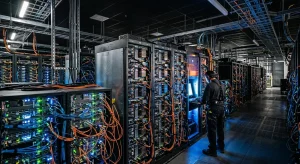
- Compliance requires continuous hardware-level governance, including cluster telemetry, hardware-root-of-trust for model weights, and component-level power sensing.
Angela Merkel’s recent address put a high-profile political voice behind one of the EU AI Act’s most contested technical details: the 10^25 FLOPs compute threshold that determines whether an AI model is classified as a systemic risk.
- Identify the theoretical peak performance of your GPU fleet. An NVIDIA H100 SXM5 module delivers approximately 989 TFLOPS of FP16/BF16 performance without sparsity.
- Apply the Hardware Utilisation Factor (HUF). Real-world training rarely reaches theoretical peaks due to interconnect bottlenecks and memory latency. Use a multiplier between 0.35 and 0.45 for a standard InfiniBand-connected cluster.
- Calculate the training duration. A cluster of 10,000 H100s running for 100 days produces cumulative compute of roughly 3.4×10^24 FLOPs, just below the systemic risk threshold. The formula: (10,000 GPUs) × (989×10^12 FLOPs/s) × (0.40 utilisation) × (8,640,000 seconds).
- Log power consumption per training run. Article 40 of the EU AI Act requires disclosure of total energy consumption. Use NVIDIA Management Library (NVML) or the nvidia-smi tool to poll power draw every 60 seconds and aggregate the kilowatt-hours consumed.
The gap between a “high-risk” and a “general-purpose” classification can come down to 10% in utilisation efficiency or a few extra weeks of training time. If that data is not logged at the hardware level, the regulator defaults to a “theoretical peak” calculation, one that is almost always less favourable to the operator. Rigorous logs are not just good practice; they are the only reliable defence during an EU AI Office inquiry.
Phase 2: Implementing Hardware-Level Governance and Monitoring
Establishing a compute baseline is only the start. The EU’s Codes of Practice require active governance infrastructure: the ability to demonstrate that no unauthorised fine-tuning or secondary training runs have pushed a model over the cumulative threshold without prior notification to the regulator. This phase moves from calculation to continuous oversight.
- Deploy cluster-level telemetry using Prometheus and Grafana. You must be able to produce a timestamped report of every GPU hour consumed against a specific model weights file.
- Enable Hardware-Root-of-Trust (RoT) for model weight protection. NVIDIA’s Confidential Computing features on H100 GPUs encrypt model weights in memory, satisfying the Act’s requirement for “appropriate levels of cybersecurity” for systemic models.
- Audit your interconnect topology. Article 24 of the EU AI Act requires documentation of where data resides during training when using a non-European cloud provider. Map your physical cable routes to confirm data does not transit regions without an adequacy decision from the European Commission.
- Establish a hardware kill-switch for output drift. If real-time monitoring flags a safety guardrail violation, your infrastructure must support immediate isolation of inference nodes, typically handled through a Kubernetes sidecar that monitors API responses and revokes the GPU pod’s network access.
Energy reporting tends to be the hardest requirement for legacy facilities to satisfy. Older data centres typically measure power only at the PDU (Power Distribution Unit) level, which bundles AI compute with cooling and auxiliary systems. Meeting the EU AI Act’s standard requires component-level power sensing, so firms can report “effective AI energy” rather than total facility consumption. The difference in reported carbon footprint can be material.
Phase 3: Deploying Localised Infrastructure for Lower Regulatory Tiers
One practical route around the systemic risk threshold is architectural. By using distributed, localised hardware rather than massive central clusters, enterprises can keep individual training runs below 10^25 FLOPs. Smaller, efficient models, Mistral 7B or Llama 3 8B, for instance, now deliver strong task-specific performance, making a “small model, many nodes” approach viable for a wider range of workloads.
- Transition inference workloads to NVIDIA L40S or A10G GPUs. These cards are optimised for inference rather than large-scale training, which reduces exposure to systemic risk audit criteria.
- Use edge AI hardware for sensitive data processing. Deploying NVIDIA Jetson Orin modules or specialised AI PCs at branch level keeps compute fragmented, it falls within the “high-risk” category but avoids the systemic tier, because the hardware cannot support a massive training run.
- Partition H100 clusters using Multi-Instance GPU (MIG) technology. Physically splitting a single GPU into up to seven independent instances provides documented evidence that hardware is being used for diverse, small-scale tasks rather than a single high-FLOPs training session.
- Select European-based sovereign clouds such as OVHcloud or Scaleway. These providers have aligned their hardware reporting with EU AI Act requirements and offer automated compliance dashboards that simplify the audit process.
These providers have aligned their hardware reporting with EU AI Act requirements and offer features to simplify the audit process.
Data residency is the final element of this phase. Under the EU AI Act, high-risk systems deployed in public services must store data within the European Economic Area. In practice, that means verifying the physical location of NVMe arrays and S3-compatible storage buckets. If an infrastructure manager cannot point to a specific rack in an EU facility, the deployment is likely non-compliant for high-risk governmental use cases.
Hardware Compliance as a Competitive Edge
The 10^25 FLOPs threshold is not going away, and according to reports, Merkel’s Brussels remarks made clear that political support for softening it is thin. Firms that treat the threshold as a design constraint rather than an administrative burden can reduce hardware spend while keeping their deployments out of the most demanding regulatory tier. Those that do not will face the EU AI Office’s default approach: theoretical peak calculations, presumptive classification and the compliance costs that follow.
A verifiable hardware audit trail, precise TFLOPS logs, Confidential Computing for model security, a localised infrastructure strategy, is what separates firms that can demonstrate compliance from those that merely assert it. As enforcement matures, that distinction will carry real weight for enterprises operating in the European market. For more coverage of AI policy and regulation, visit our AI Policy & Regulation section.