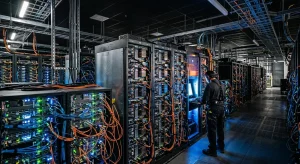
- The orbital data center market is projected to reach $39 billion by 2035.
- SpaceX aims to orbit a million data-center satellites, and China approved its first space computing innovation center in early June.
- AI is increasingly used in autonomous space operations, including Mars rover drives and ISS robot movement planning.
SpaceX wants to put a million data-center satellites into orbit. That single ambition captures what is now a two-front race: the energy and land required to run AI on the ground are running short, and space, for all its engineering brutality, is starting to look like a serious alternative. China moved in the same direction in early June, approving Beijing’s first space computing innovation center to coordinate rocket makers, satellite developers, chipmakers and AI companies under one national programme.
The Orbital Data Center Market Takes Shape
ADA Space, another Chinese firm, launched 12 satellites in early 2025 as the first tranche of a planned 2,800-satellite network designed for on-orbit AI processing.
The hardware story is already in orbit. One demonstration satellite, Starcloud-1, is carrying an Nvidia H100 GPU to train a Google AI model in space. That is a real H100, the same chip powering most large-scale terrestrial training runs, now operating in an environment it was never designed for. The engineering gap between a data-center-grade GPU and a space-qualified processor is enormous, which makes Starcloud-1’s existence the most concrete proof yet that the sector is moving beyond concept papers. For context on how aggressively private capital is chasing AI infrastructure at every layer, see our coverage of Krutrim’s AI cloud ambitions.
AI Takes Control of Autonomous Space Operations
NASA’s Perseverance rover began using AI-planned drives in early 2026. The software charts routes across Jezero Crater by analysing terrain, wheel performance and scientific priorities, cutting the need for constant ground commands from Earth. That matters because a one-way radio signal to Mars takes between three and 22 minutes depending on orbital geometry; waiting for human approval on every navigation decision is operationally unsustainable at scale.
The Ingenuity Mars Helicopter completed 72 autonomous flights over Martian terrain before its mission concluded in January 2024 after sustaining rotor blade damage. Stanford researchers reported a 50% to 60% acceleration in movement planning for robots aboard the International Space Station after integrating machine learning in 2025.
Edge AI and the Data Deluge in Low Earth Orbit
Satellite numbers are rising fast. From roughly 15,000 currently in orbit, projections put the figure at 100,000 by 2030 and potentially half a million by the late 2030s. Each satellite generates data. Collectively, they generate more than existing ground infrastructure can efficiently process, which is pushing AI processing onto the satellites themselves.
The European Space Agency’s Φ-sat-2 mission is one of the clearest examples: edge AI onboard filters cloud cover, detects ground changes and compresses data before transmission, so only the most valuable observations make it back to Earth. That filtering step is not optional on deep-space missions where communication delays run from minutes to hours. Mega-constellations like Starlink already use automated maneuvering to avoid collisions; fully autonomous orbital traffic management is the next engineering target as orbit gets more crowded.
Radiation, Regulation and Market Concentration
Space is hostile to electronics. Radiation damages chips, temperature swings stress solder joints and micrometeorites can end a mission instantly. NASA and Microchip Technology are testing a next-generation radiation-hardened space computer chip claimed to perform hundreds of times better than current spaceflight processors while surviving those conditions. Getting commercial-grade AI silicon to work reliably in that environment, at scale, remains an unsolved problem.
The Brookings Institution flagged a different concern in January 2026: concentrating space AI infrastructure in a handful of capital-intensive companies and nations risks locking out smaller countries from Earth observation data and the AI algorithms that process it. Agricultural monitoring, national security intelligence and disaster response all depend on satellite data. If that data sits behind foreign commercial platforms, dependency becomes a strategic vulnerability. The scramble for orbital slots and radio spectrum is already intensifying those tensions, and no coordinated governance framework exists yet to manage it. For more coverage of AI chips and infrastructure, visit our AI Hardware section.