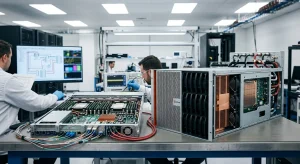
- Apple is reportedly developing an enterprise AI server targeting a 2029 launch, built around two or four M8 Ultra chips, according to The Information.
- Apple has reportedly discussed NVLink Fusion with Nvidia, covering the interconnect protocol, switches, chiplets and software, though the integration is unconfirmed and the project could proceed without it.
- OpenAI has reportedly purchased tens of thousands of Mac mini and Mac Studio units for AI agent development, and Anthropic has reportedly rented Mac minis through Amazon Web Services for similar purposes, giving Apple an organic commercial foothold it could convert into dedicated server revenue.
Apple is reportedly planning its return to the enterprise server market for the first time since discontinuing the Xserve in 2011, and its first potential customer may already be one of the most recognizable names in AI: OpenAI has reportedly purchased tens of thousands of Mac mini and Mac Studio units for AI agent development, handing Apple an unexpected commercial foothold in a market it has yet to officially enter.
Apple Targets 2029 AI Server Launch
Eighteen years after killing the Xserve, Apple is reportedly building a dedicated enterprise AI server, according to The Information. The project, initiated roughly a year ago and backed by John Ternus, then Apple’s hardware engineering chief and now, as of September 1, 2026, its CEO, centres on its future M8 Ultra chip and targets a 2029 launch. Configurations under consideration include two or four M8 Ultra processors. Apple has not confirmed any of this.
What the M8 Ultra Needs to Deliver
The M-series architecture’s unified memory is the main draw for inference workloads. The current M5 Ultra supports up to 512GB of unified memory at 1.2TB/s bandwidth, which gives it strong local model capacity. For comparison, Nvidia’s H200 reaches 4.8TB/s, reflecting a fundamentally different design philosophy rather than a straight performance gap. Scaling that architecture into a data centre rack introduces thermal and connectivity problems Apple hasn’t had to solve before. The Apple M6 arrived in August, which puts the M8 Ultra several chip generations out, giving the company time to work through advanced packaging and refine instruction sets for its own AI models.
The Nvidia Interconnect Question
Apple currently uses its own UltraFusion to bridge two SoCs. For a multi-chip server at data centre scale, that may not be enough. The reported discussions with Nvidia concern NVLink Fusion, which covers the full stack: the interconnect protocol, switches, chiplets and software. That scope makes it a substantial collaboration between two companies competing in the same chip market. The integration is not confirmed, and the project could proceed without it.
Why Servers, Why Now
The commercial pull is already visible. OpenAI has reportedly purchased tens of thousands of Mac mini and Mac Studio systems for AI agent development, while Anthropic has rented Mac minis through Amazon Web Services for similar purposes. Apple already runs its own server hardware for Private Cloud Compute, handling AI inference that exceeds local device capacity. A dedicated enterprise product would let Apple convert that organic demand into a defined revenue line, reduce dependence on third-party cloud infrastructure and give it tighter control over performance and power efficiency for its own AI workloads. For enterprise buyers, it could also simplify the privacy argument Apple has been making for Private Cloud Compute.
Execution Risk and a Crowded 2029
A 2029 launch puts this server into a market that will look considerably different from today’s. Nvidia, the major hyperscalers and a widening field of custom silicon vendors will all have had several more years of iteration by then. Winning enterprise infrastructure deals requires more than good performance-per-watt numbers: it takes supply commitments, long-term roadmaps and integration support that data centre buyers can plan around. The project also faces a near-term materials constraint: a global shortage of memory chips could complicate production of a server whose entire value proposition rests on large, high-bandwidth memory. The Information notes the project could still be cancelled or significantly changed, including the Nvidia piece.