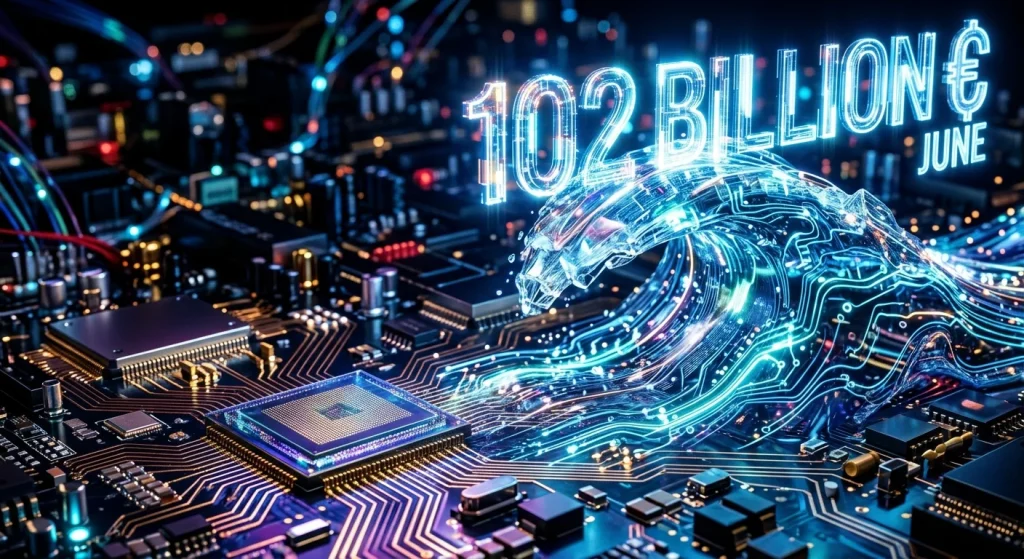
- South Korea’s exports hit a record $102.25 billion in June 2026, up 70.9% year-on-year, with semiconductor shipments from Samsung and SK Hynix nearly tripling to $44.82 billion on the back of AI data center demand.
- HD Hyundai Electric and Hyosung Heavy Industries secured over 1.4 trillion won (approximately $904.6 million) in new overseas contracts for AI data center power infrastructure in North America and Australia.
- Samsung and SK Hynix plan to invest approximately $518 billion to build four new semiconductor fabs, targeting doubled memory output within five years, with high-bandwidth memory for AI data centers as the primary focus.
South Korea just posted the fastest export growth since 1978, and the semiconductor numbers behind it are striking: monthly chip shipments tripled to $44.82 billion, the first time Korea has crossed $40 billion in a single month. The trigger is straightforward, every major AI data center build requires high-bandwidth memory, and Samsung and SK Hynix make most of it.
Semiconductor Exports Triple Amid HBM Demand
June semiconductor exports rose 199.5% to $44.82 billion. That figure is driven almost entirely by high-bandwidth memory (HBM), the stacked DRAM architecture that sits directly on AI accelerator packages and feeds them data fast enough to keep GPU compute units from starving. Samsung and SK Hynix together control close to 80% of the global HBM market, according to the company, making them the default suppliers to hyperscalers and accelerator manufacturers like Nvidia.
SK Hynix has moved furthest, cementing its position as Nvidia’s primary HBM supplier through years of early investment in what was once a niche product category. Both companies have reported record profits in recent quarters. Jefferies analysts anticipate memory prices could rise around 50% per quarter through 2027, with a further 40% to 45% increase expected that year, though independent verification of those projections remains limited. If the pricing trajectory holds alongside volume growth, Korea’s semiconductor export figures have room to climb further.
Power Equipment Manufacturers Secure Massive Deals
The infrastructure pull goes well beyond chips. According to a recent report by The Dong-a Ilbo, HD Hyundai Electric signed a long-term framework agreement valued at up to 1.1212 trillion won (approximately $724.5 million) with a major global technology company building data centers across North America. The contract covers both distribution and transmission equipment as a bundled package, reflecting the reality that large-scale AI data centers need integrated power infrastructure, not just compute.
Hyosung Heavy Industries secured a five-year exclusive supply contract worth 310 billion won (approximately $200.3 million) with AusNet, a transmission grid operator in Victoria, Australia. The deal involves ultra-high-voltage transformers and reactors, the hardware that stabilises grid connections and handles long-distance transmission at the scale AI data centers require. Together, the two contracts total over 1.4 trillion won in new overseas business from power infrastructure alone.
Korea’s $576 Billion Investment in AI Infrastructure
President Lee Jae Myung has announced plans to invest more than 800 trillion won (approximately $576 billion) in semiconductor manufacturing and AI infrastructure, in a programme developed with Samsung and SK Hynix. Of that total, Samsung and SK Hynix plan to contribute approximately $518 billion to build four new semiconductor fabrication plants in Korea’s southwestern region, focused on HBM production for AI and data center markets.
The stated goal is to double memory chip output within five years. The investment also covers advanced chip packaging, AI data center construction and broader semiconductor supply chain development. President Lee described semiconductors, physical AI and AI data centers as the “triple axis” of South Korea’s future industrial strategy. Whether the full $576 billion materialises on that timeline is an open question, but the direction of the commitment is clear: Korea is betting its industrial future on being the memory layer for global AI compute. The scale of that bet puts it in the same conversation as the orbital data center race and other long-horizon AI infrastructure plays now being funded at national scale.
Beyond Chips: Cooling and Power Solutions Diversify Exports
AI workloads are thermally brutal. A dense GPU rack running continuous inference can consume well over 100 kW and generates heat that conventional air cooling struggles to handle at scale. Korean researchers at the Korea Advanced Institute of Science and Technology (KAIST) recently unveiled a liquid cooling technology the institute says could cut semiconductor cooling power consumption to roughly one-tenth of current levels, though independent validation is ongoing.
On the commercial side, S-Oil is piloting liquid immersion cooling under its “S-Oil E-Cooling Solution” brand for data center deployments. Samsung is pursuing the acquisition of European HVAC firm FläktGroup and establishing production of heat pumps and air handling units in Gwangju, targeting the data center cooling market directly. LG Electronics is developing advanced liquid cooling systems and working toward Nvidia certification for its solutions. Meanwhile, a partnership between Wise Integration, Powernet and KEC is co-developing switched-mode power supply (SMPS) units for AI servers using gallium-nitride (GaN) power devices, a semiconductor material that handles high switching frequencies more efficiently than silicon, enabling denser, more efficient power delivery at the rack level. Korea’s export story, in other words, now runs from the memory die to the cooling loop. For more coverage of AI chips and infrastructure, visit our AI Hardware section.