- Micron Technology and SK Hynix have collectively pledged over $45 billion to expand High Bandwidth Memory production capacity.
- All three major HBM suppliers, SK Hynix, Micron, and Samsung, report sold-out capacity through 2026.
- New HBM capacity commitments will not meaningfully ease supply before 2027 at the earliest.
Micron has already sold every HBM chip it will make this year. So has SK Hynix. So has Samsung. The race to build more is on, but the fabs won’t be ready in time to matter for the current AI procurement cycle, and the three companies spending tens of billions to fix that know it.
Why HBM became the AI bottleneck
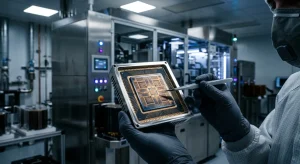
The shift started with the architecture of modern AI accelerators. Nvidia‘s H100, and now its Blackwell-generation GPUs, require memory that can feed data fast enough to keep thousands of cores busy simultaneously. Conventional DRAM can’t do it. High Bandwidth Memory solves the problem by stacking multiple DRAM dies vertically and connecting them through microscopic vertical channels called Through-Silicon Vias (TSVs). The result is memory bandwidth roughly 10 times faster than standard DRAM, at lower energy per bit transferred.
Without enough HBM, even the fastest GPU is throttled. The chip sits idle, waiting on data. That constraint has made HBM less of a component and more of a gating factor for the entire AI hardware stack, and it’s why the compute thresholds regulators are now watching depend as much on memory supply as on raw processing power.
The HBM market was worth around $4 billion in 2023. How large it grows from here depends on which forecasts you trust, but the direction isn’t in dispute.
Billions poured into expansion
The three dominant HBM suppliers are all spending at a scale that would have been hard to imagine five years ago. SK Hynix announced a $15 billion investment in February 2026 focused on HBM3, HBM3E and early HBM4 capacity. Its total committed spend across new advanced packaging and fabrication plants in the US and South Korea is reported to exceed $30 billion, with around $27 billion expected in fiscal 2026 alone. The M15x expansion in South Korea remains dedicated to HBM lines.
The M15x expansion in South Korea remains dedicated to HBM lines. Micron Technology raised its fiscal 2026 capital expenditure to $20 billion, up from a previously planned $18 billion, anchored around its Idaho mega-fabs.
Micron Technology raised its fiscal 2026 capital expenditure to $20 billion, up from a previously planned $18 billion, anchored around its Idaho mega-fabs. A separate $7 billion HBM assembly facility in Singapore adds geographic diversification. Micron’s total fiscal 2026 capex could exceed $25 billion when both programmes are counted.
Micron’s total fiscal 2026 capex could exceed $25 billion. Samsung Electronics is also running at sold-out capacity for 2026, advancing HBM4 mass production and HBM4e development in parallel.
Samsung Electronics is also running at sold-out capacity for 2026, advancing HBM4 mass production and HBM4e development in parallel. The company recently passed the $1 trillion market capitalisation mark, with HBM demand cited as a primary driver, according to reports.
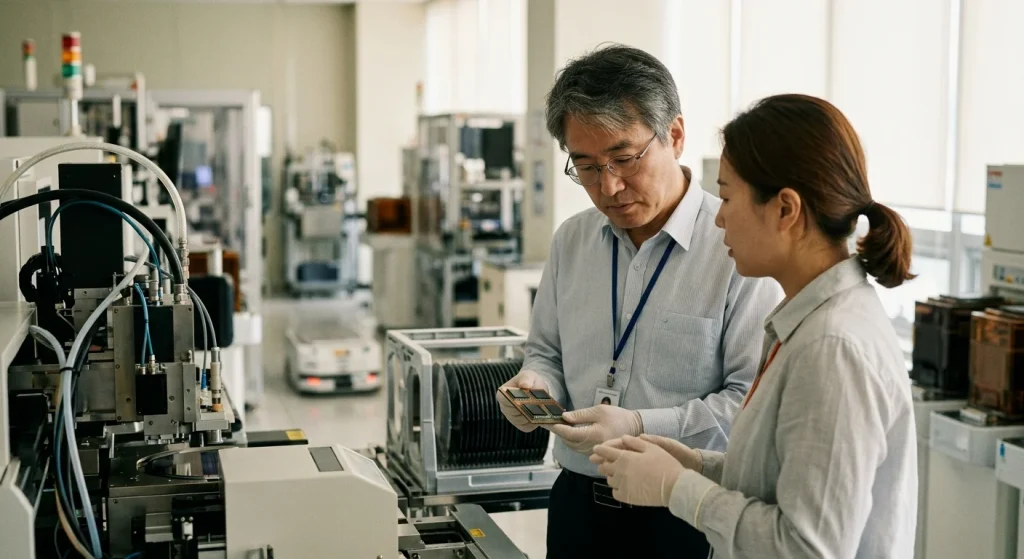
The capital intensity here is not incidental. Advanced HBM packaging requires specialised equipment, long construction timelines and high fixed operating costs. The fabs being announced today won’t ship product before late 2026 or 2027. That timeline gap, between commitment and output, is what keeps supply tight even as the investment numbers grow.
The memory supercycle and its costs
Capacity sold out plus surging demand equals pricing power. Memory prices climbed sharply year-over-year in 2025, and TrendForce data from early May 2026 indicates conventional DRAM contract prices rose significantly quarter-over-quarter in Q1 2026, with further increases expected in Q2. The long-term contracts and direct hyperscaler relationships that now characterise HBM deals are a structural departure from the spot-market commodity cycles that historically defined DRAM pricing.
There are real costs to the rest of the market. Wafer capacity diverted to HBM is wafer capacity not making conventional DRAM or NAND flash. Gartner estimates conventional DRAM prices could rise substantially in 2026, with NAND flash prices rising even more sharply. For smaller memory and SSD manufacturers, the combination of tight supply and elevated prices is forcing significant debt load; one recent report noted some companies borrowed $880 million just to buy enough chips to operate.
The semiconductor industry has been through supply cycles before. The standard risk is that simultaneous capacity expansion by all three major producers creates oversupply within two to three years. What may differ this time is the complexity and wafer footprint of HBM relative to commodity DRAM, it takes more capacity to make the same number of units, and production qualification for each new generation is a months-long process. Whether that complexity buffers this cycle against the usual oversupply dynamics is not yet clear. The pace of TSMC’s own capacity ramp gives some indication of how the broader supply chain is positioning itself.
What comes next
HBM4 is the immediate frontier. SK Hynix, Samsung and Micron are all in various stages of HBM4 development and production qualification, targeting integration with Nvidia’s Rubin platform. Yields and certification timelines from each supplier will be the real variables shaping pricing and availability through 2027. The suppliers that certify first will likely lock in the most favourable long-term contracts.
The broader picture is straightforward: memory suppliers have moved from commodity producers to strategic chokepoints in the AI compute chain. That shift changes their capital allocation, their customer relationships and their margins. How durable those advantages are depends on whether AI infrastructure spend holds at current levels, and on how quickly the fabs now being built come online. For more coverage of AI chips and infrastructure, visit our AI Hardware section.