- HBM now accounts for 63% of AI chip component costs across designs from Nvidia, AMD, Google and Amazon, making it the largest single cost driver in AI hardware.
- Microsoft has raised Xbox prices by $100 to $150, effective August 1, 2026, with broader PC and smartphone price increases expected through the year as HBM costs flow downstream.
- New HBM fab capacity won’t come online until 2034 to 2035, meaning enterprises planning AI infrastructure over a three-to-five year horizon should treat memory availability as a hard constraint, not a commodity assumption.
HBM memory now makes up 63% of AI chip component costs, and the companies buying it, from Nvidia to Google, cannot get enough of it. The shortage is structural, the new capacity is years away, and the price pressure is already hitting consumer devices. Here’s what’s driving it and what it means for enterprise AI budgets.
HBM Becomes the Dominant AI Chip Cost Driver
Averaged across chip designs from Nvidia, AMD, Google and Amazon, HBM has grown into the single largest component cost in AI silicon. That wasn’t true three generations ago. It is now.
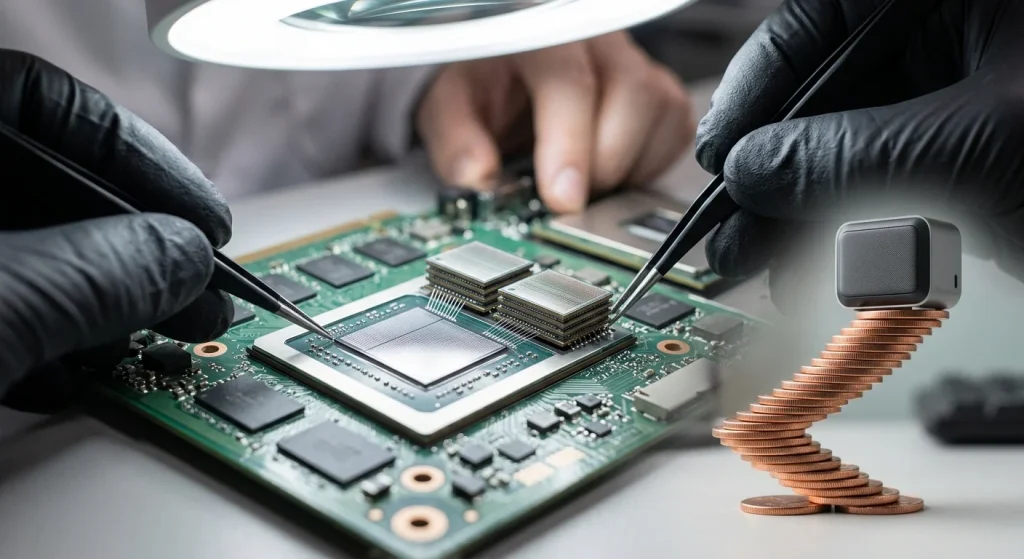
The shift from HBM3 to HBM3E is the main driver. Next-generation chips require eight to 12 HBM stacks each, and stacking is not simple. The manufacturing process depends on through-silicon vias (TSVs), tiny vertical electrical connections drilled through silicon layers, and precision multi-die assembly. That complexity is why suppliers cannot spin up output overnight, and why the shortage is structural rather than a temporary inventory blip.
Consumer Device Prices See AI-Driven Spikes
Microsoft announced Xbox console price increases of $100 to $150, set to take effect on August 1, 2026. PC and smartphone prices are expected to rise through 2026 compared to 2025 levels, driven by the same chip cost pressures flowing downstream from AI data centre demand.
Memory Manufacturers Invest Billions in New Capacity
Samsung Electronics and SK Hynix, which together hold a dominant share of the global HBM market, are set to announce a combined investment package worth $646 billion for new semiconductor production facilities in South Korea, with new facilities targeting completion as early as 2034 to 2035. SK Hynix, which recently surpassed Samsung as South Korea’s most valuable listed company, had already committed $15 billion in February 2026.
Micron Technology has projected strong HBM revenue growth through 2028 and has set a substantial capital spending budget for fiscal 2026. The commitments are significant. The timelines are long.
Enterprise AI Budgets Shift Towards Cost-Per-Token
Soaring memory costs are pushing enterprises to measure AI spend differently. Raw compute power is giving way to cost per token as the metric CFOs care about, because it directly ties infrastructure cost to revenue-generating output. Nvidia argues that optimising for cost per token is the critical factor for scaling AI profitably, according to the company. Gartner projects significant growth in total worldwide IT spending, with cloud and AI infrastructure accounting for most of the year-on-year increase. For enterprises already weighing how to get more from existing AI deployments, the shift toward output-based metrics is worth tracking alongside the broader competition reshaping the AI chip market.
AI-Driven Demand Creates Prolonged Memory Supercycle
This shortage is not a normal inventory cycle. Previous memory crunches, including the pandemic-era disruptions, were largely demand spikes against stable manufacturing capacity. This one is structurally different: HBM production is separate from conventional DRAM, requires specialised equipment, and is being prioritised for AI data centres because the margins are higher. Conventional memory buyers are competing for what’s left.
According to TrendForce, memory contract prices for conventional DRAM increased roughly 90% to 95% quarter-on-quarter in Q1 2026, with NAND Flash prices rising roughly 55% to 60% over the same period. Micron has reportedly been sold out of HBM production for 2026, with orders extending into 2027. Kearney’s PERLab predicts the shortage will last until at least 2030. Micron CEO Sanjay Mehrotra has said gradual supply improvements are expected only by 2028, according to the company.
The underlying mechanic is geometric: each new generation of AI GPU requires more HBM stacks than the last. More stacks means more manufacturing steps, more yield risk and more fab time per chip. Supply growth is linear; demand is not. For enterprises planning AI infrastructure over a three-to-five year horizon, memory availability and pricing are now strategic constraints. That framing applies equally to the custom silicon bets that vendors are making to reduce their exposure to merchant chip costs. For more coverage of AI chips and infrastructure, visit our AI Hardware section.